Posters presented at research conferences.
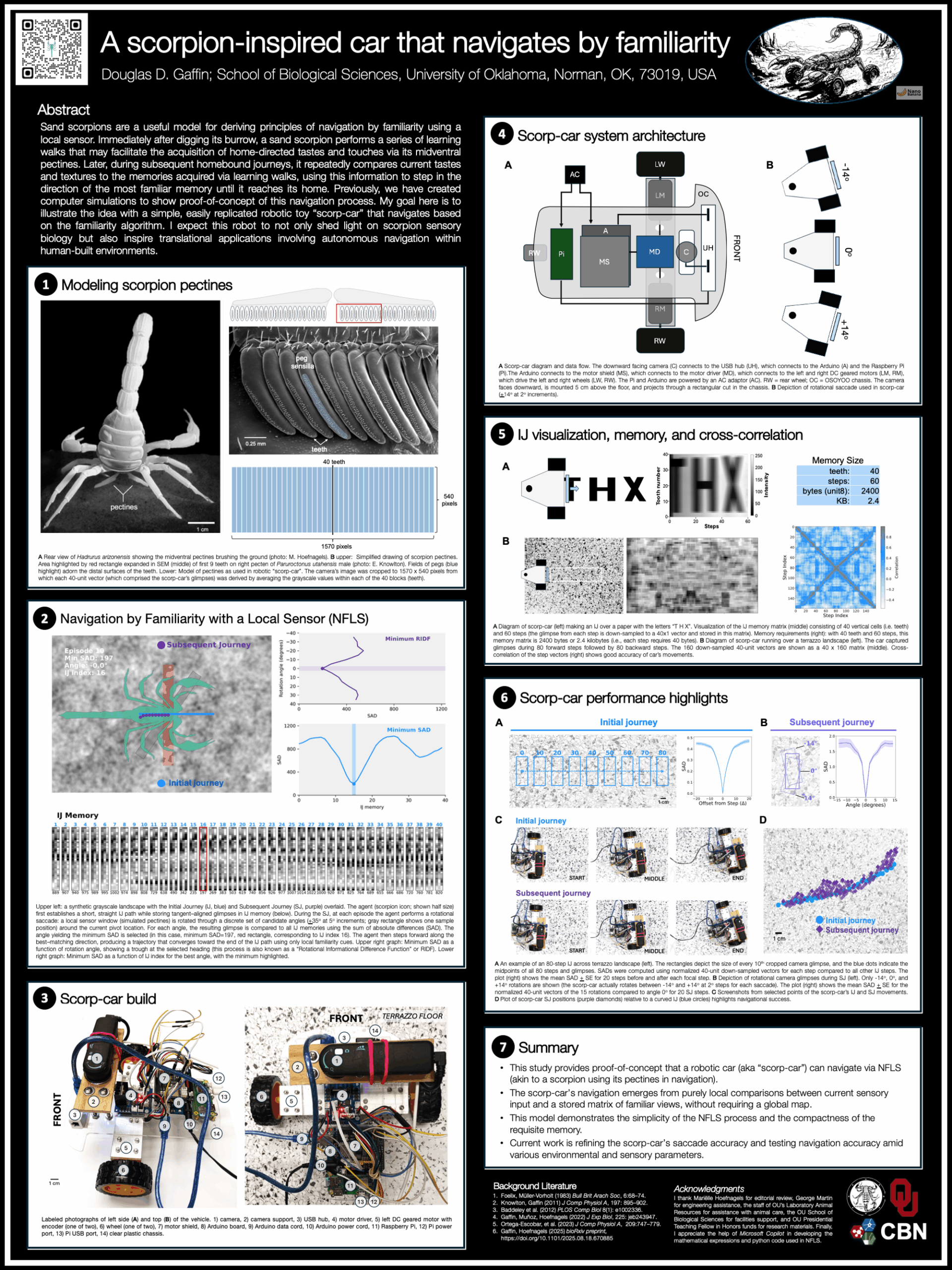 | 2026 American Arachnological Society – Lincoln, Nebraska, USA. A scorpion-inspired car that navigates by familiarity Douglas D. Gaffin |
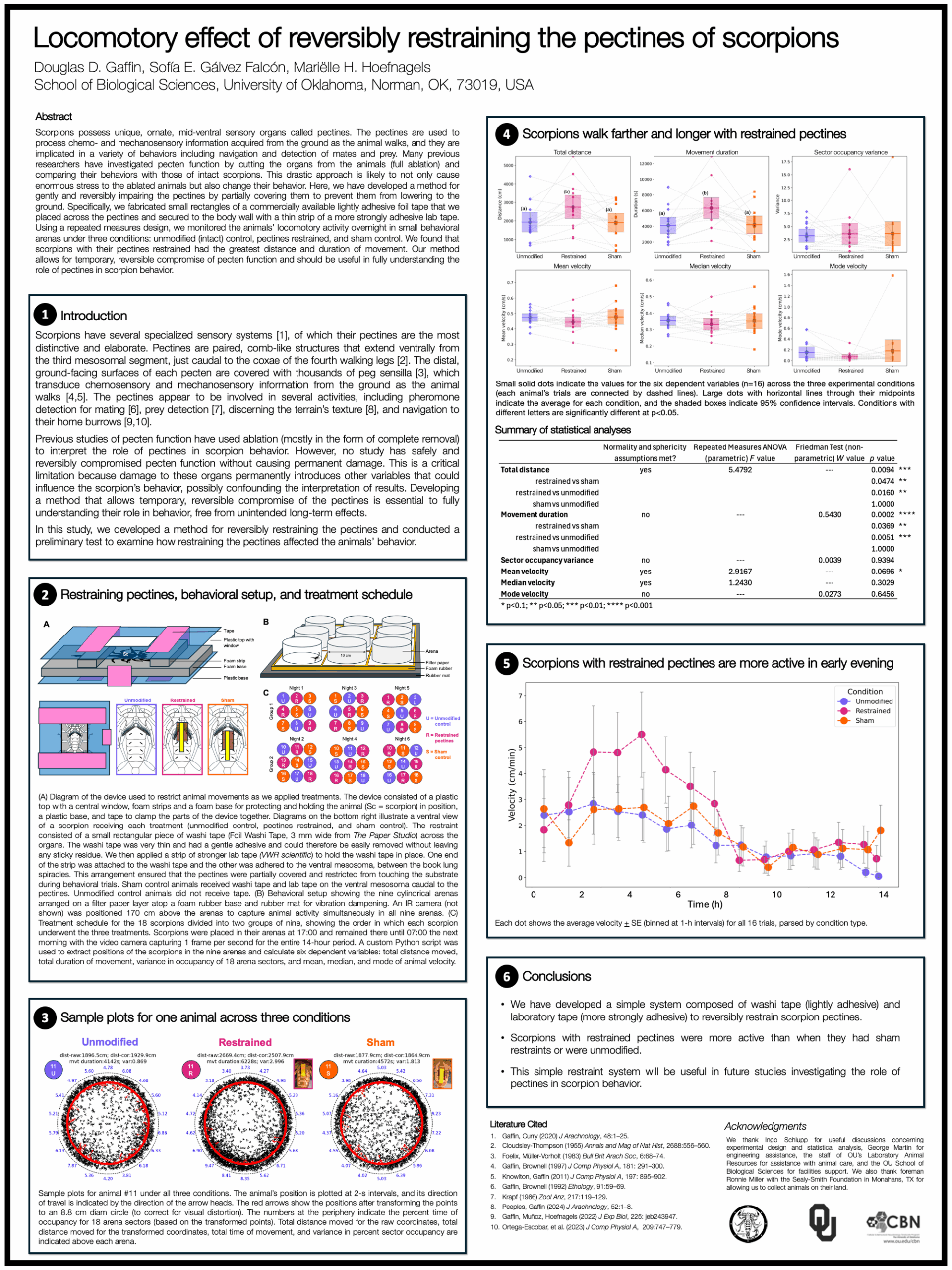 | 2025 American Arachnological Society – Golden, Colorado, USA. Locomotory effect of reversibly restraining the pectines of scorpions Douglas D. Gaffin, Sofía E. Gálvez Falcón, & Mariëlle H. Hoefnagels |
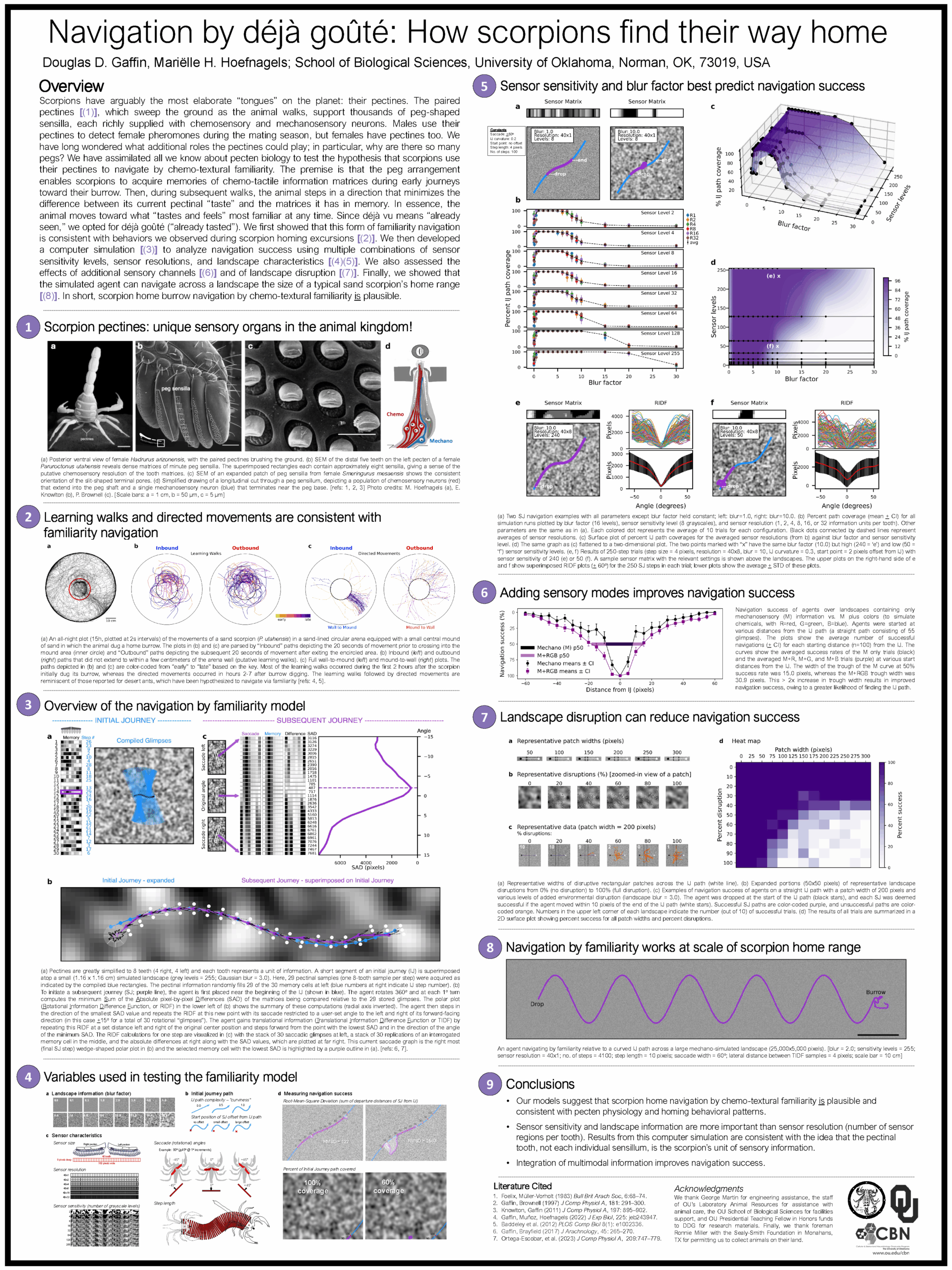 | 2025 American Arachnological Society – Golden, Colorado, USA. Navigation by déjà goûté: How scorpions find their way home Douglas D. Gaffin & Mariëlle H. Hoefnagels |
 | 2022 American Arachnological Society – Davis, California, USA. Investigating homing by path integration in desert grassland scorpions. Alexis Merchant & Douglas Gaffin |
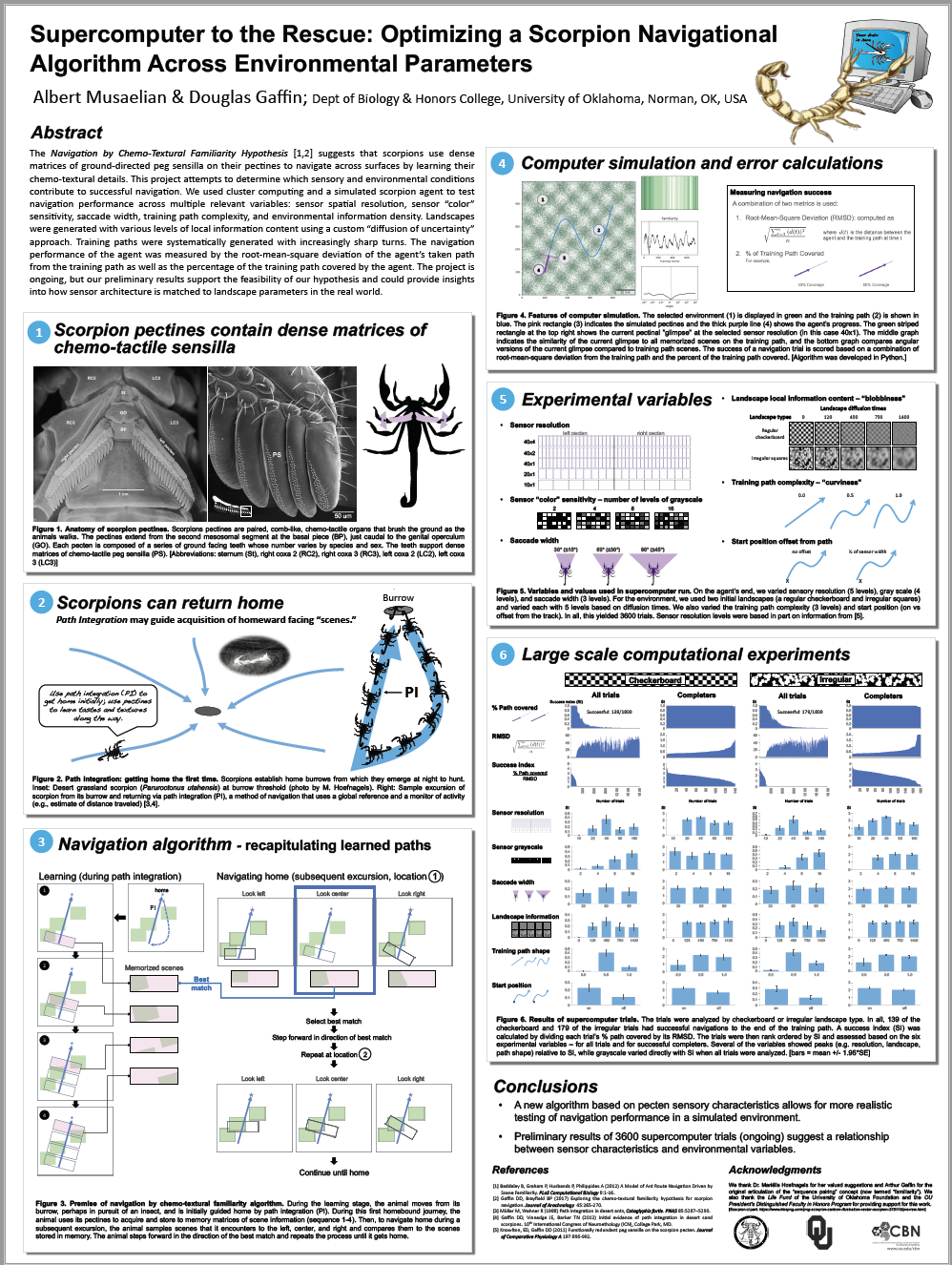 | 2019 American Arachnological Society – Lexington, Virginia, USA. Supercomputer to the rescue: Optimizing a scorpion navigational algorithm across environmental parameters. Douglas D. Gaffin & Albert Musaelian |
 | 2017 American Arachnological Society – Querétaro, Juriquilla, Mexico. New, sensitive behavioral assay shows that scorpions respond to UV, green, and red light. Ninoshka M. Rivera Roldan & Douglas D. Gaffin |
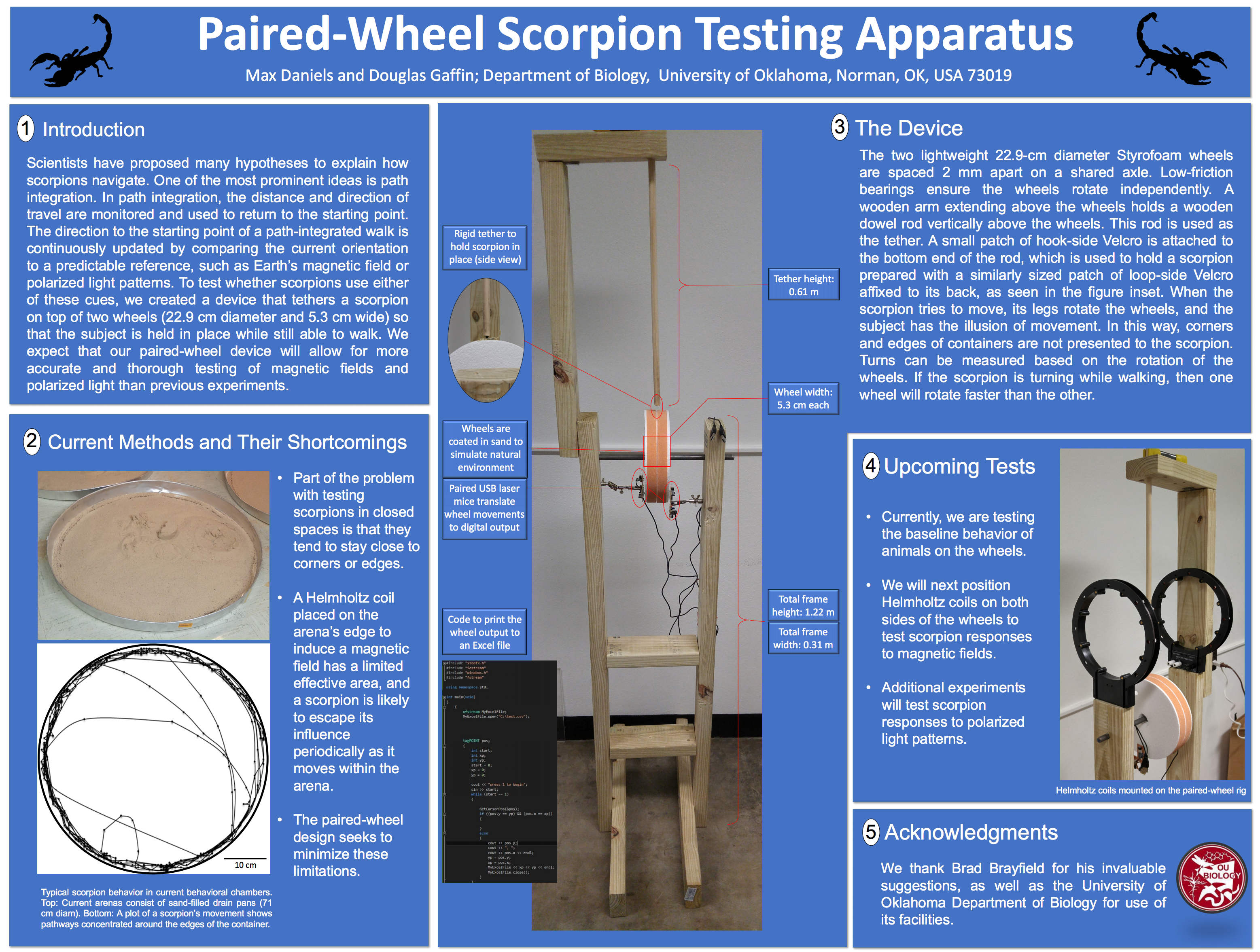 | 2016 OU Summer Undergraduate Research Symposium – Norman, OK, USA. Paired-wheel scorpion testing apparatus. Max Daniels & Douglas D. Gaffin |
 | 2015 Gordon Research Conference – Neuroethology: Behavior, Evolution, Neurobiology – Lucca, Italy. Indoor autonomous visual navigation using an insect inspired familiarity algorithm. Douglas D. Gaffin & Brad Brayfield |
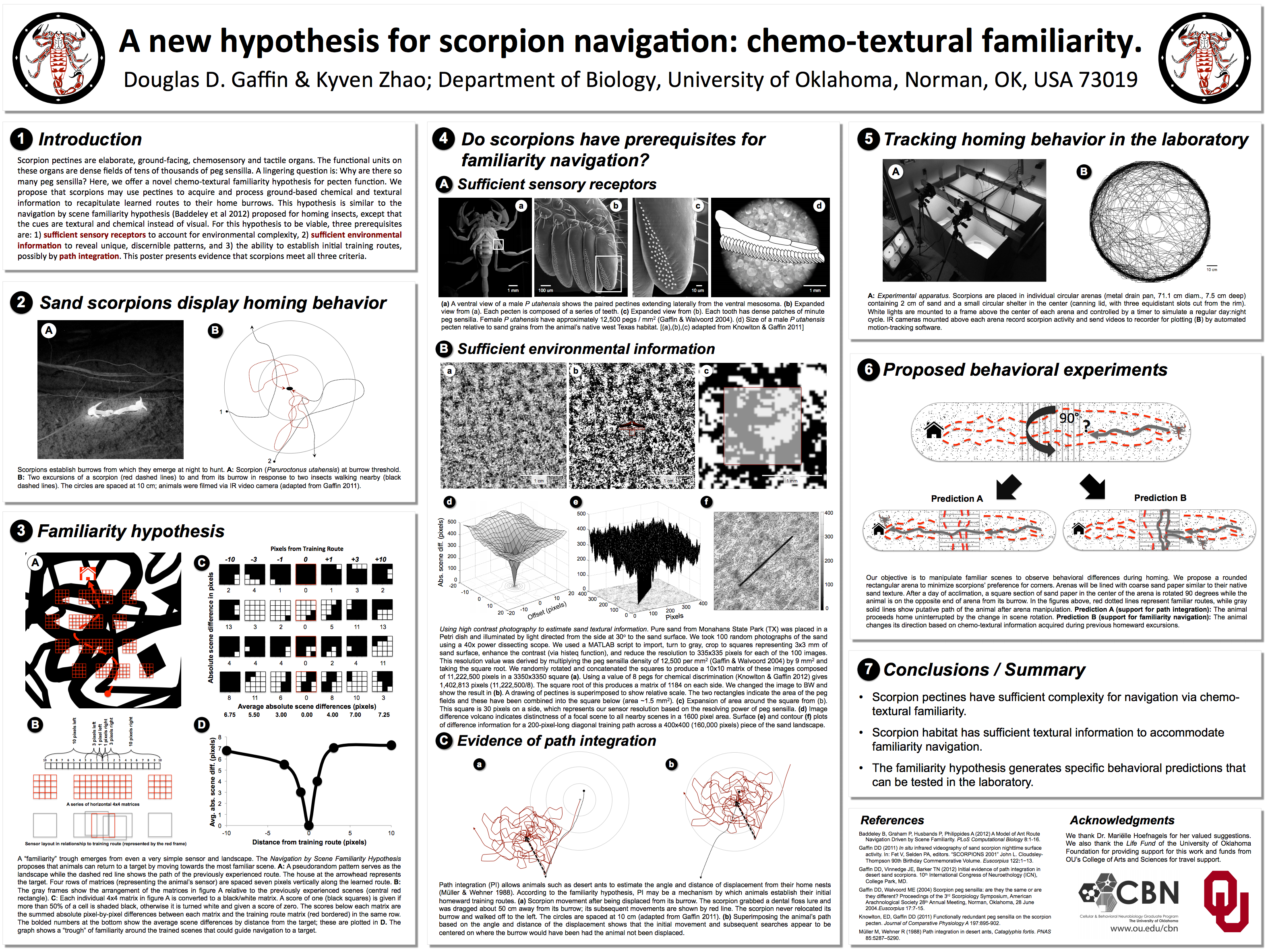 | 2014 American Arachnological Society – Newark, Ohio, USA. A new hypothesis for scorpion navigation: chemo-textural familiarity. Douglas D. Gaffin & Kyven Zhao |
 | 2014 American Arachnological Society – Newark, Ohio, USA. In-lab homing behavior and movement patterns in Paruroctonus utahensis. Jay Vinnedge & Douglas D. Gaffin |
 | 2012 International Society of Neuroethology – College Park, Maryland, USA. Initial evidence of path integration in desert sand scorpions. Douglas D. Gaffin, Jay E. Vinnedge, & Tristan N. Barker |
 | 2011 American Arachnological Society – Portland, Oregon, USA. Scorpion fluorescence and reaction to light. Douglas D. Gaffin, Lloyd Bumm, Matthew S. Taylor, et al. |
 | 2010 International Society of Neuroethology – Salamanca, Spain. “Hasty tasting” of chemical information: functionally redundant peg sensilla on the scorpion pecten. Elizabeth D. Knowlton & Douglas D. Gaffin |
 | 2009 American Arachnological Society – Russellville, Arkansas, USA. Going out for dinner and taking a new way home: videotaping the scorpion’s evening walk. Douglas D. Gaffin |
 | 2008 American Arachnological Society – Berkeley, California, USA. A new approach to examining scorpion peg sensilla: the mineral oil flood technique. Elizabeth D. Knowlton & Douglas D. Gaffin |
 | 2007 International Society of Neuroethology – Vancouver, Canada. Scorpion peg sensilla: a rapid, parallel-sampling system for acquiring ground-based, chemosensory information. Douglas D. Gaffin |
 | 2004 American Arachnological Society – Norman, Oklahoma, USA. Non-visual orientation of desert sand scorpions. Ryan McKee & Douglas D. Gaffin |
 | 2002 American Arachnological Society – Riverside, California, USA. Response of male Centruroides vittatus to aerial and substrate-borne chemical signals. Steffany Steinmetz & Douglas D. Gaffin |
 | 1998 International Society of Neuroethology – San Diego, California, USA. Response properties of scorpion pectinal nerves to chemical and mechanical stimulation. Douglas D. Gaffin & Elizabeth A. Camp |